Light-as-air pavlova: the best use of leftover egg whites (with 9 simple tips)
If you’ve have leftover egg whites from making ice cram this summer, use them to make pavlova! Just follow these 7 simple tips to make this delicious and light treat.
A delicious, light cake that is crunchy on the outside and a fluffy marshmallowy pillow on the inside. Topped with mountains of lightly sweetened, whipped cream, delicious ripe strawberries and raspberries and tangy lemon curd to help cut through the sweetness. My mouth is watering, but I’m Australian. I know what I’m missing.
If you have been following our Ice ice Baby series and made any of our egg-based ice creams, you will probably have leftover egg whites. So what should you do with
Make pavlova. Delicious, light-as-air pavlova. The perfect afternoon treat.
And we’ve got 9 simple tips to help make sure your pavlova is perfect!

Short & sweet
Taste: Like sugary marshmallow pillows, all light and fluffy and sweet.
Ease: Simple. Just follow our 9 tips religiously.
Pros: A great way to use up your leftover egg whites.
Cons: The long cooking and cooling time and that you can’t assemble it too far in advance.
Again: Definitely. Perhaps for an Australian afternoon tea.
Disclosure:
Some of the links below are affiliate links. As an Amazon Associate, I earn from qualifying purchases. Please read our full disclosure for more information.
What is pavlova?
Pavlova is an iconic Australian dessert. Most Australians would say it is Australia’s national dish. If it wasn’t for the debate over whether it was invented in New Zealand or Australia, this would probably be the case.
Pavlova is named after Russian prima ballerina Anna Pavlova, who toured Australia in 1926. It is a meringue-based cake with a crisp crust that is ‘as light as air’ inside, just like Anna Pavlova was when she danced.
I had never made it from scratch
I’m Australian and I bake reasonably regularly. Pavlova is an easy recipe to pull out when you have to make something ‘typically Australian’ for a function. It’s perhaps a surprise that I have never made a pavlova before. At least, I have never made it from scratch.
I have always cheated and either used a mix or purchased one from the supermarket. Yes, pavlovas are so popular in Australia you can buy packet mixes and pavlova bases ready for topping at the supermarket. We used pre-made pavlovas for our wedding…
Even using a mix, I have not always had success. I tried to make one memorable pavlova while I was studying in Germany. I say tried as it remained runny, no matter how long it was in the oven. And it was in the oven for a
With some trepidation, I decided to make pavlova from the egg whites remaining after making Bailey’s Irish ice cream. Luckily, the pavlova was as successful as the ice cream.
Tips for the perfect pavlova
Pavlova is surprisingly easy, as long as you adhere to a few rules.
- Make sure your bowl and whisk attachment are super clean. Even a little bit of fat will stop your leftover egg whites from turning white and fluffy. Give the bowl and risk attachment an extra wash in warm water with soap before using them to whip egg whites and dry them well.
- Use unexpired but older eggs, e.g., 4 days old. Older eggs will yield more voluminous, fluffier meringue. As eggs age, the whites get thinner and the liquid is better able to drain from the “bubbles” forming the meringue.
- Once you’ve used your egg yolks, make sure you use your leftover egg whites to make this pavlova within 24 hours. Older (separated) egg whites will not go white and fluffy as well and you risk salmonella poisoning.
- Use superfine (caster) sugar, not just regular sugar. Regular white sugar is too heavy and won’t give you that light-as-air consistency.
- Use regular vinegar (distilled white vinegar) in the pavlova. Flavoured vinegar will just make the pavlova taste funny. However, strawberries and balsamic vinegar and basil glaze can be fantastic as a topping.
- Use a fan-forced oven.
- If your pavlova is starting to brown too quickly, turn the temperature on your oven down. Do NOT open the door.
- Do NOT open the oven door until the oven is completely cool. This will normally be about one hour after turning off the heat but might vary depending on your oven. If you open it too early, your pavlova with sink.
- Wait until shortly before you need your pavlova to top it with cream and fruit. If you top it too early, your pavlova will soak up the moisture from your cream and the crust will go soggy.

The perfect mound of leftover egg whites
One thing I wish I had done better was to form the pavlova a little better before placing it in the oven. I just heaped it on the tray.
To get a better form, you can draw a perfect circle on baking paper and heap your whipped leftover egg whites into the middle of the circle. Then take your silicone spatula and form the egg whites into a nice round shape with a flat top and even nice ridges on the sides.
I am not suggesting you go all out for great-tasting pavlova. However, perhaps something in between anally sculpting the egg whites and just dumping them in a pile on the tray would be nice.
Tip: dab a little bit of the whipped egg whites (about the size of a 10c coin) on each corner of the tray and “glue” your baking paper in place to stop it from flapping around with the fan
What toppings to use on your light-as-air pavlova
Top your pavlova with cream and fruit. Use the cream and fruit to hide any inevitable cracks in your pavlova (yes, you will probably have cracks). Can you tell I have had to do this on more than one occasion?
There is some debate about what traditionally goes on top of a
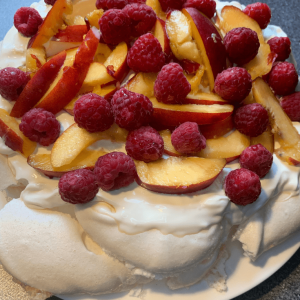
As far as fruit is concerned, it really is anything goes. Traditionally, it would be strawberries, kiwi fruit, and passionfruit. Personally, I like raspberries and strawberries. Today, I used nectarines and raspberries, because that is what I had on hand.
Some people prefer to have chocolate on their pavlova. Strawberries with chocolate shavings are common. I have even seen After Eight chocolate mints on pavlova before.
And lemon curd goes really well, too, especially with strawberries or raspberries.
What if I want individual pavlovas for my afternoon tea?
Individual pavlovas are perfect for afternoon tea. You can even top them with different fruit to give your guests more choice.
To make mini pavlovas, draw 10 cm circles on your baking paper to use as a guide. Spoon your egg white mixture into the circles. Your mixture should make about 6 mini pavlovas.
Mini light-as-air pavlovas will not take as much time to bake or cool, either. Instead of an hour for each, reduce the time by half to 30 minutes baking time and 30 minutes cooling time.
Make sure you wait until
Can I make it in advance?
You can make the base (meringue) of the pavlova in advance but do not add any cream or toppings. Store the pavlova in an airtight container somewhere cool, but not in the fridge.
Wait until the final hour to top the meringue with your cream and fruit. Meringues will absorb moisture from the cream (and sugar, which is hygroscopic), which will soften the pavlova quickly. Once the cream has been added, the pavlova will need to be refrigerated, which will make the pavlova soggy.
You can prepare your cream and refrigerate it (in an airtight container) until needed. Stir your cream before using it for better consistency. You can also do the same with your fruit (squeeze lemon juice on your fruit if it is likely to turn brown).
What do you do with your leftover pavlova?
Assuming you have leftover pavlova – no guarantees it will be the case – it can be used for Eton mess. It was one of Mum’s favourite desserts – she would order Eton mess regularly when we went out for dinner.
Make sure you use your leftover pavlova within 24 hours. Store it in an airtight cake container.
What is Eton mess? A mixture of strawberries or red berries, whipped cream and/or vanilla ice cream, and broken meringue. Mess refers either to its appearance or because it was ‘eaten in
What do you do with your leftover egg yolks?
This pavlova recipe is great for using egg whites. But what do you do with the egg yolks?
You make have already used your egg yolks to make ice cream and just be looking for a use for your leftover egg whites.
Or you might want to make pavlova and be looking for a way to use the egg yolks. Try lemon curd, any of our egg-based ice creams, or our spaghetti carbonara.
Light-as-air pavlova: a delicious Australian treat
What are you doing with your leftover egg whites?
If you have a few and you’re looking for a light and delicious treat for your next afternoon tea or barbecue that you can flavour any way you want, this simple pavlova recipe is perfect. Of course, you can always make the pavlova and then find another use for the egg yolks…
Do you know a more delicious use for egg whites?

Pavlova
Equipment
- flat baking tray
Ingredients
- 4 egg whites
- 1 cup of fine castor sugar
- 3 tsp. cornflour corn starch
- 1 tsp. normal vinegar
- Topping
- Whipped cream
- Fruit or topping of your choice
Instructions
- Preheat the oven to 150°C fan-forced.
- Whisk the egg whites until soft peaks form.
- Continue whisking the egg whites and add the sugar, little by little, until they become glossy.
- Sift the cornflour over the egg mixture and mix it in.
- Fold in the vinegar.
- Heap the egg white mixture onto a lined baking tray. The ‘heap’ should have an approximate circumference of 18 cm.
- Place the tray in the middle of the oven and immediately turn down the heat to 120°c. If your oven runs hot, turn it down to 100°c.
- Bake for one hour, then turn off the heat, keep the door closed and leave the pavlova in the oven until the oven completely cools. This will normally take about an hour.
- Spread with whipped cream and top with the fruit or toppings of your choice.
Notes
Nutrition




I regularly have egg whites left over from different things so I’ll have to give this a try 🙂 Looks fantastic!
Good luck!
This is the article I’ve been looking for! I always have leftover egg whites and end up throwing them away. But not anymore. The pavlova looks amazing and I can’t wait to make it. Thank you for the tips as well!
I actually had my egg whites in a sealed container in the fridge for 2 days before I got a chance to use them and the pavlova still turned out fine. Good luck!